
Bookmatched Slabs: How Mirrored Stone Veining Works
Bookmatched slabs are two neighboring slabs from the same block, finished so their veining mirrors across a seam like the pages of an open book. Granite Global, a family-owned slab distributor in Charlotte, NC, explains how the effect is made, where it works well, what it asks of your fabricator and what to check at the warehouse before you commit to a mirrored layout.
Bookmatched Slabs: The Short Answer
Bookmatching turns a seam into a design feature. Granite Global explains it simply: two slabs sawn one after the other from the same block carry almost the same veining, so finishing their touching faces and opening them like a book creates a mirror image. It needs the right stone, the right slabs and a careful fabricator.
Bookmatching is the practice of matching two or more wood or stone surfaces so that neighboring pieces mirror each other, like the two facing pages of an open book.
The term is familiar from woodworking veneer, and the Wikipedia entry on bookmatching notes that it also works with marble and other patterned stone. With stone, the mirror effect depends on veining that is bold enough to read across a room.
Granite Global supplies the slabs; your fabricator measures, templates, cuts and installs them, and the mirrored layout is planned between you, your designer and your fabricator.
How Sequential Slabs Create the Mirror Effect
A block of stone is sawn into slabs like a loaf of bread, so slab two starts where slab one ends. Granite Global points out that the faces that touched inside the block are nearly identical. Bookmatching shows those two faces side by side, which usually means one slab is finished on its back side.
Sawing the block
The quarry block is cut into consecutive slabs, which are often numbered in the order they came off the saw.
Finishing the touching faces
For a mirror image, the two faces that were next to each other in the block are the ones polished, honed or leathered.
Opening the book
One slab is flipped next to the other, so the veining meets at the seam and mirrors outward.
Cutting in sequence
The fabricator lays out each piece so the veins line up at the seam and keeps every cut piece in order.
Slabs that are all finished on the same face are often called sequential slabs. A fabricator profiled by Stone World in a study of a bookmatched bathroom explains that the job needed a bed polisher to finish the back side of the stone, and that slabs cannot be bookmatched out of sequence.
That is why the slab numbers and lot matter as much as the material name when you plan a bookmatched design.
Where Bookmatched Stone Works Well
Bookmatching pays off where a large, uninterrupted surface sits at eye level or at the center of a room. Granite Global sees it chosen most for statement islands, full-height backsplashes, fireplace walls and shower walls. Small runs of countertop broken up by a sink, cooktop and corners rarely show the mirror clearly enough.
| Location | Why it works | Watch out for |
|---|---|---|
| Kitchen island | A wide, open top where the mirror line can run down the center | Seam placement, overhang support, slab size |
| Full-height backsplash | A vertical wall at eye level shows the pattern like artwork | Outlets and windows that interrupt the veining |
| Fireplace surround | A focal wall where symmetry suits the design | Matching the mirror line to the firebox center |
| Shower walls | Large panels with few cuts give a dramatic, continuous look | Every piece must stay in sequence during fabrication |
| Waterfall island ends | Veins can wrap from the top down the side panel | Extra stone needed and precise mitered corners |
On islands, the mirror line becomes a seam that must be supported and aligned, so read our guide to countertop overhang support before you finalize the size.
Which Stones Show Bookmatching Well
Bookmatching needs veining with direction and contrast. Granite Global suggests looking at marbles, dolomites and quartzites with long, flowing veins, because speckled granites and very uniform stones hide the mirror effect. Every slab is unique, so choose by the actual slabs in a lot, not by the name or a photo.
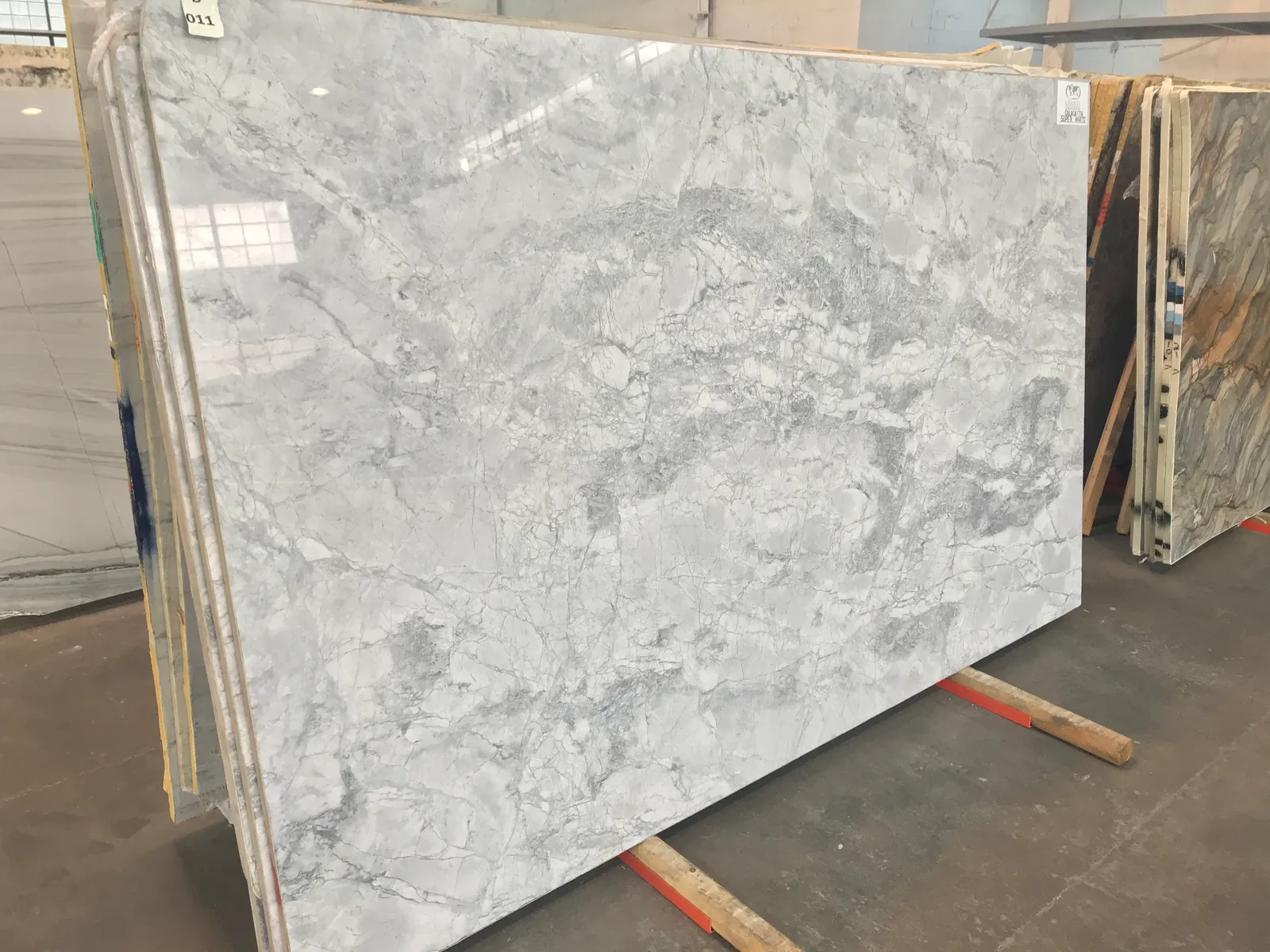
Calacatta Super White
A white dolomite with bold gray veins that can read clearly across a mirrored seam.
See Calacatta Super White dolomiteTaj Mahal
A warm quartzite with soft, flowing movement for a quieter mirrored look.
See Taj Mahal quartziteWhite Carrara
A classic white marble with fine gray veining, well suited to bath and fireplace walls.
See White Carrara marble
If you are leaning toward a veined white for a kitchen, compare durability in our guide to dolomite for kitchen countertops, then browse our slab inventory and call (704) 348-4485 to check availability.
What to Check at the Slab Yard for a Bookmatch
Granite Global recommends a few extra checks when a design depends on mirrored slabs. Confirm the slab numbers are consecutive, look at both faces, check the veining runs where the seam will be, and photograph everything. Ask our team whether sequential slabs are available for the material you like before you fall in love with a layout.
- Ask whether consecutive, numbered slabs from the same block are available
- Check the slab numbers and lot on every label
- Look at the face of each slab and, if possible, the back of the neighbor
- Hold the slabs side by side in your mind at the planned seam line
- Confirm the slab size covers the island or wall without extra seams
- Plan one extra slab if the layout is large or the design is complex
- Photograph each slab, its label and the veining near the edges
- Share the numbers with your fabricator before anything is cut
When you have a shortlist, visit our Charlotte slab warehouse at 7517 Orr Road; walk-ins are welcome and no appointment is needed.
Common Mistakes With Bookmatched Designs
Most bookmatching problems Granite Global hears about start before fabrication. Designs get drawn around one photo, slabs from different lots get mixed, or a layout ignores sinks and outlets that cut through the mirror line. Planning the seam, the sequence and the cutouts together, with your fabricator, avoids nearly all of them.
| Mistake | What happens | How to avoid it |
|---|---|---|
| Designing from a photo | The real slabs show different veining at the seam | Choose the actual consecutive slabs in person |
| Mixing lots | Color and veins do not mirror | Keep every slab from the same block and sequence |
| Ignoring cutouts | A sink or outlet breaks the mirror line | Place cutouts away from the center of the pattern |
| No spare stone | A broken piece cannot be replaced from another block | Discuss a spare slab with your fabricator |
| Choosing a speckled stone | The mirror effect barely shows | Pick stones with long, directional veins |
Bookmatching usually takes more stone than a standard layout, so confirm the slab count with your fabricator before you order.
Sources and References
Granite Global used the sources below for the definitions and fabrication points in this guide. One explains what bookmatching is in wood and stone, and the other describes a real bookmatched stone installation, including why slabs must stay in sequence. Open them to read the original wording and details.
- Wikipedia: Bookmatching (https://en.wikipedia.org/wiki/Bookmatching): definition of bookmatching and its use with marble and other patterned stone.
- Stone World: A Study in Book-Matching (https://www.stoneworld.com/articles/87111-a-study-in-book-matching): slabs cannot be bookmatched out of sequence, back-side polishing and use in shower walls, floors and vanities.
Every stone and every block is different, so treat these as general guidance and confirm the details for your project with your fabricator.
Questions About Bookmatched Slabs
What is the difference between bookmatched and sequential slabs?
Sequential slabs are consecutive slabs cut from the same block, usually all finished on the same face, so their pattern repeats in the same direction. Bookmatched slabs are consecutive slabs finished on the faces that touched in the block, so the pattern mirrors across the seam. Sequential slabs give a consistent flow; bookmatched slabs give symmetry.
Does Granite Global have bookmatched slabs?
It depends on the material and the lot that arrived. Ask the Granite Global team whether sequential slabs are available for the stone you like, and call (704) 348-4485 to check availability before your visit. Then plan the mirrored layout with your fabricator, who measures, cuts and installs the stone.
Can any stone be bookmatched?
Technically many stones can be, but the effect only shows on stones with bold, directional veining, such as many marbles, dolomites and quartzites. Speckled granites and very uniform quartz show little or no mirror image. Choose by looking at the actual slabs and how the veins run toward the edges where the seam will sit.
How many slabs does a bookmatched island need?
At least two consecutive slabs, because the mirror is made from a pair. Larger islands, waterfall ends or matching backsplashes may need more, plus a possible spare. Your fabricator calculates the count from your measurements and the slab sizes, so bring their drawing when you visit Granite Global.
What happens if a bookmatched piece breaks during fabrication?
Because the mirror depends on neighboring slabs from one block, a broken piece cannot simply be replaced with any other slab of the same name. That is why many fabricators discuss a spare consecutive slab or a fallback layout for complex bookmatched designs. Talk this through with your fabricator before cutting begins.
Is bookmatching only for kitchens?
No. Bookmatched stone is often used on fireplace walls, shower walls, bathroom vanities and feature walls, where large panels show the symmetry clearly. In kitchens it works well on islands and full-height backsplashes. Wherever you use it, plan the seam line and cutouts so the mirrored veining stays visible.
Plan Your Bookmatched Design in Person
Shortlist veined marbles, dolomites and quartzites online, then visit our Charlotte warehouse and ask whether sequential slabs are available for the material you like.