
Brazilian Granite Colors: A Guide to the Main Families
Brazilian granite colors cover almost every countertop look, from warm golds and soft creams to crisp whites, deep blues, rich greens and dramatic blacks. Granite Global is a family-owned stone distributor in Charlotte whose team comes from Brazil, and many of the granites in our warehouse are quarried there. This guide sorts the main color families, explains how each one looks in a real kitchen and helps you narrow the choice before you visit.
- Many granites quarried in Brazil
- Inventory updated every day
- Walk-ins welcome
Why Brazilian Granite Comes in So Many Colors
Granite Global explains that Brazil's range of granite colors comes from its geology: very old rock formations with different mixes of feldspar, quartz, mica and other minerals, some reshaped by heat and pressure over time. Feldspar drives most of the color, quartz adds grey or clear grains, and dark minerals add specks and veins.
Commercial granite is the trade name for a wide group of hard, crystalline stones used for countertops. It includes true granite and related rocks such as gneiss and migmatite, which explains why some Brazilian granites show flowing movement instead of an even speckle.
- Feldspar
- Usually the main color source: white, cream, pink, gold or even blue tones.
- Quartz
- Grey to clear grains that add depth and sparkle.
- Mica and dark minerals
- Black or brown specks, flecks and veins that create pattern and contrast.
- Garnet
- Small burgundy or red dots that appear in many Brazilian whites and golds.
Because the mineral mix changes inside a single quarry, two slabs with the same name can differ, which is why Granite Global always recommends seeing the actual slab.
The Main Brazilian Granite Color Families Compared
Granite Global groups Brazilian granite colors into six practical families so homeowners can narrow choices fast. Golds and creams feel warm, whites brighten a room, blues and greens make a statement, blacks add contrast, and burgundy tones bring depth. The table shows how each family usually behaves in a kitchen.
| Color family | Typical look | Pairs well with | Shows dirt and crumbs |
|---|---|---|---|
| Golds and creams | Warm speckle, gold and brown flecks | Cream, white or wood cabinets | Hides well |
| Whites | Light ground with grey, black or burgundy specks | White, grey or navy cabinets | Shows some spills |
| Blues | Blue crystals or blue-grey movement | White cabinets, simple backsplash | Hides well |
| Greens | Dark green with lighter flecks | Cream or wood cabinets | Hides well |
| Blacks | Dark ground, sometimes with white or gold specks | Almost any cabinet color | Shows dust and water spots |
| Burgundy tones | Cream or grey with burgundy and brown movement | White or warm wood cabinets | Hides well |
Use the families to build a short list, then compare the real slabs side by side under daylight in the warehouse before you make the final call.
Gold and Cream Brazilian Granites
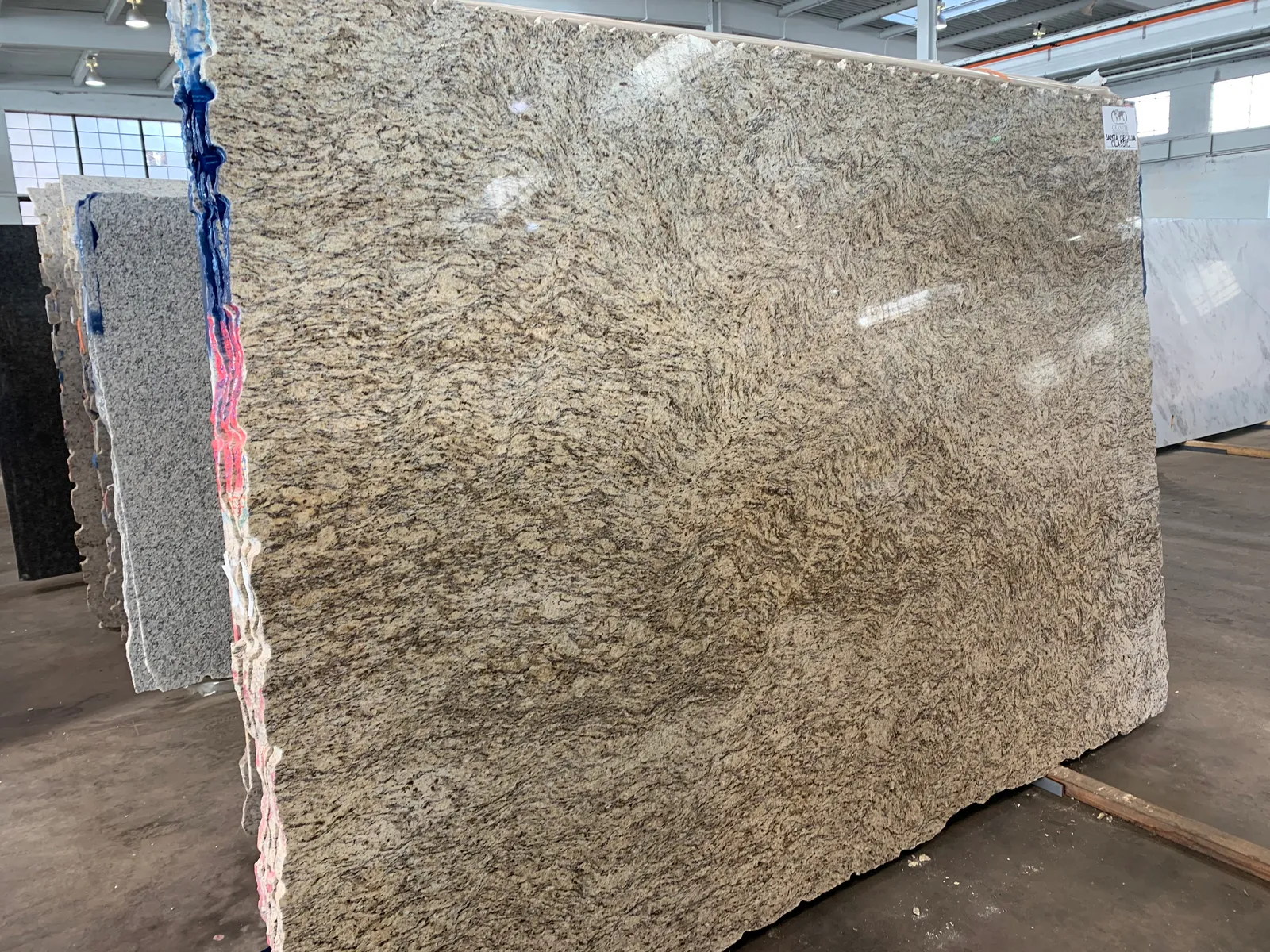
Granite Global sees gold and cream Brazilian granites chosen by homeowners who want a warm, welcoming kitchen that hides daily crumbs. These stones usually have a cream or gold background with brown, black and burgundy flecks. They pair naturally with cream, white and wood cabinets and with warm-toned floors.
Names you will find in this family in our granite inventory include Giallo Ornamental, Amarelo Icarai, Santa Cecilia Classic, New Venetian Gold and Colonial Cream. Their exact tone varies by lot, so some slabs read more yellow and others more beige.
If you are updating cabinets to white, check a gold sample against the new door color first; some golds look warmer next to bright white than you expect.
White Brazilian Granites for Bright Kitchens
Granite Global finds white Brazilian granites among the most requested colors for modern and transitional kitchens. They offer a light, bright surface with natural speckle or movement, and they are a durable natural stone alternative for homeowners who love a white countertop but want more heat tolerance than many other white materials provide.
In this family you will see names such as Colonial White, Alaska White, Bianco Antico, Delicatus White and Dallas White in our inventory. Some are soft and even, others show grey waves or small burgundy garnets. Our guide to white granite countertops covers how to choose among them.
Lighter granites can be more absorbent than darker ones, so ask your fabricator about sealing and do a water drop test on the slab you choose.
Blue and Green Brazilian Granites
Granite Global recommends blue and green Brazilian granites for homeowners who want the countertop to be the focal point. Blues range from bright crystal patterns to soft blue-grey movement, and greens are usually deep and dark with lighter flecks. Both work best with calm cabinets and a simple backsplash that does not compete.
Blue family
Look for names such as Azurite and Blue Fantasy. Blue granites are often among the more distinctive stones in a slab yard.
Green family
Look for names such as Ubatuba and Peacock Green. Dark greens read almost black from a distance and hide daily use well.
Statement blues and greens often arrive in small lots, so if one catches your eye, check its status in the live inventory and plan your visit soon.
Black and Burgundy Brazilian Granites
Granite Global sees black and burgundy Brazilian granites chosen for contrast and depth. Blacks range from solid dark grounds to stones with white or gold specks and veins, and leathered finishes add texture. Burgundy tones usually show cream or grey backgrounds with wine-colored and brown movement, bringing warmth without looking yellow.
In our inventory, the dark family includes names such as Via Lactea, with its white veins over black, and Black Cosmic Leathered. Burgundy tones include Typhoon Bordeaux, Sienna Bordeaux and Neptune Bordeaux. Many of these names are well known as Brazilian granites; ask our team to confirm the origin of any specific slab.
Very dark polished granite shows dust, water spots and fingerprints more than mid-tones, so consider a leathered or honed finish if that bothers you.
How to Choose a Brazilian Granite Color, Step by Step
Granite Global suggests choosing color in a fixed order: start from what stays in the room, pick a color family, shortlist a few names, then compare the real slabs in daylight. This keeps the decision focused on how the granite will look in your kitchen, not just how it looks in a photo.
Start with what stays
Note cabinet color, floor tone, wall paint and hardware finish. Bring samples or photos to the visit.
Pick one or two families
Choose warm golds, bright whites, statement blues or greens, contrasting blacks or warm burgundy tones.
Shortlist three names
Check the live granite inventory for names in stock and coming soon in your families.
Compare real slabs
Look at full slabs side by side in daylight, including the back slabs behind the first one.
If you are torn between granite and a quartzite with a similar look, our comparison of quartzite vs granite explains how the two differ in hardness and care.
Common Mistakes When Choosing Granite Color
Granite Global sees a few color mistakes repeat often: choosing from a small sample or a screen, judging color under warehouse light only, ignoring how the slab changes across its length and forgetting how many slabs the kitchen needs. Each one is easy to avoid with a little planning before and during the visit.
- Picking from a phone photo; screens shift color and photos are only representative
- Seeing a 4-inch sample instead of the full slab and its movement
- Not checking cabinet and floor samples next to the slab
- Forgetting that a kitchen may need two or more slabs from the same lot
- Choosing a very busy granite and then a busy backsplash that competes with it
Before you pick, confirm how many slabs your layout needs; our guide to granite slab sizes explains typical dimensions and how they affect seams.
Brazilian Granite Color Checklist for Your Visit
Granite Global recommends a short checklist so your visit ends with a confident choice instead of more questions. With samples, measurements and a shortlist in hand, our team can show you the slabs in your color family, including slabs behind the first one, and help you compare them in the warehouse.
- Cabinet door or paint sample
- Floor sample or a clear photo of the floor
- Countertop measurements or a rough sketch
- A shortlist of names from the live inventory
- Photos of the kitchen in daylight
- Your fabricator's name, if you already have one
Walk-ins are welcome during business hours. Check the granite slabs in stock before you leave home, then visit our Charlotte slab warehouse to see them in person.
Questions About Brazilian Granite Colors
What are the most popular Brazilian granite colors?
White and cream granites are among the most requested for modern kitchens, followed by warm golds and dark blacks for contrast. Statement blues and greens are chosen by homeowners who want the countertop to stand out. Granite Global stocks granites across all these families, and the live inventory shows what is available each day.
Is Brazilian granite good quality?
Brazil is one of the world's major sources of granite, and many widely used countertop granites come from Brazilian quarries. Quality depends on the specific stone and slab, not only on the country. Look at the real slab for fissures, resin repairs and consistency, and ask your fabricator for an opinion before you commit.
Does Brazilian granite need to be sealed?
Most granites benefit from sealing, but how often depends on the stone. Lighter, more open-grained granites tend to absorb more than dense dark ones. A simple test is a few drops of water: if the stone darkens quickly, it needs sealing. Your fabricator usually seals the countertops at installation.
Why do two slabs with the same name look different?
Granite forms naturally, so the mineral mix changes inside a quarry and between blocks. Slabs from different lots can vary in tone, pattern and size. That is why Granite Global recommends choosing all the slabs for one project together and seeing the actual slabs instead of relying on photos.
Which Brazilian granite colors hide dirt best?
Busy, medium-toned granites hide crumbs, water spots and fingerprints best, such as gold, cream and burgundy families with plenty of speckle. Solid blacks and very plain whites show more. If low maintenance is your priority, a patterned mid-tone granite is usually the easiest to live with.
Can I see Brazilian granite slabs in Charlotte without an appointment?
Yes. Walk-ins are welcome at the Granite Global warehouse in Charlotte during business hours, no appointment needed. Check the live granite inventory first, then come in to see the full slabs. Our team can show you slabs behind the first one and help you compare colors.
See Brazilian Granite Colors in Person
Check today's granite inventory online, then walk into our Charlotte warehouse to compare the full slabs in your color family.