
Countertop Seams in Stone: Where They Go and How to Plan
Most stone kitchens have at least one joint, and planning countertop seams before templating is what keeps them quiet. Granite Global, a family-owned slab distributor in Charlotte, NC, explains why seams happen, where fabricators usually place them, how islands and L-shapes change the plan, and how the slab you choose makes a seam easier or harder to hide.
Countertop Seams: The Short Answer
Granite Global tells customers that countertop seams are normal in natural stone and are planned, not accidental. A seam joins two pieces when the run is longer than a slab, the shape is an L or U, or a piece is too large to carry in safely. Good placement and matching make most seams hard to notice.
A countertop seam is the narrow joint where two separately cut pieces of stone meet, filled with a color-matched adhesive and leveled so the surface reads as continuous.
| Reason | Example |
|---|---|
| Run longer than the slab | A long wall of cabinets |
| Corner shapes | L-shaped and U-shaped kitchens |
| Island larger than the slab | Very long or very deep islands |
| Access | Narrow stairs, hallways or tight turns |
| Strength around cutouts | Thin strips of stone beside a sink or cooktop |
Because Granite Global supplies the slabs and your fabricator cuts them, the seam plan comes from your fabricator; ask to see it on a layout before anything is cut.
What Makes a Seam Visible
Granite Global points to one main reason seams stand out: the stone on each side does not match. A stone trade article explains that if color and veining do not blend through the joint, nothing else makes the seam disappear. Chipped edges, out-of-square cuts and a poorly leveled joint make it more noticeable.
In In Pursuit of the Invisible Seam, a fabricator writing for Stone World lists poor color or vein matching and chipping from the saw cut among the causes of visible seams, and describes matching the stone on each side before cutting.
| What to check | What you want to see |
|---|---|
| Color across the joint | The same tone on both sides |
| Pattern across the joint | Veins or flecks that continue or flow |
| Surface | A flat, level joint you cannot catch with a fingernail |
| Edge | A clean edge with no chips filled with adhesive |
A seam you can see in raking light is normal in natural stone; a seam that breaks the pattern or catches your finger is worth raising with your fabricator.
Where Fabricators Usually Place Seams
Granite Global sees fabricators balance four things when they place countertop seams: the slab size, the strength of the stone, how the pieces reach the kitchen and how the joint looks. Every layout is different, so your fabricator will explain the trade-offs. These are the common considerations to discuss before templating day.
| Location | What fabricators weigh |
|---|---|
| Near the sink | Thin stone strips around a cutout can be fragile, so seams are often kept away from them |
| Over a dishwasher | No cabinet box below, so many fabricators avoid unsupported seams there |
| Inside corners of an L | A natural break point, but may cut through a bold vein |
| Across an island | Placement affects seating, the look from the main room and the pattern |
| Near the wall or end of a run | Often less visible, if slab length allows |
Ask your fabricator to mark every seam on the layout and to explain why each one sits where it does.
Island Seams, L-Shapes and Large Layouts
Granite Global sees the most seam questions on large islands. If an island is longer or deeper than the slabs available, it needs a seam or a second slab. Many clients prefer an island without a joint, so measure your island against the slab sizes before you fall in love with a specific stone.
- Measure the island length and depth, including the overhang
- Ask the slab size for each stone on your shortlist
- Ask whether the island fits on one slab, or where the seam would fall
- Check how the overhang is supported if a seam sits near seating
- Confirm all slabs come from the same lot for color consistency
Seating overhangs need their own planning; our guide to countertop overhang support explains when brackets or corbels come in.
How Slab Choice Changes Seam Visibility
Granite Global helps customers think about seams while choosing the stone, not after. Calm, evenly speckled granites hide joints easily because the pattern repeats. Bold veined stones and stones with strong movement show any break in the pattern, so they need matched pieces, careful layout and sometimes more slab to get the flow right.
| Pattern type | Seam visibility | Planning tip |
|---|---|---|
| Uniform speckled granite | Low | Standard layout usually works |
| Granite with gentle movement | Medium | Ask to align movement across joints |
| Bold veined stone | High | Plan matched pieces and layout before cutting |
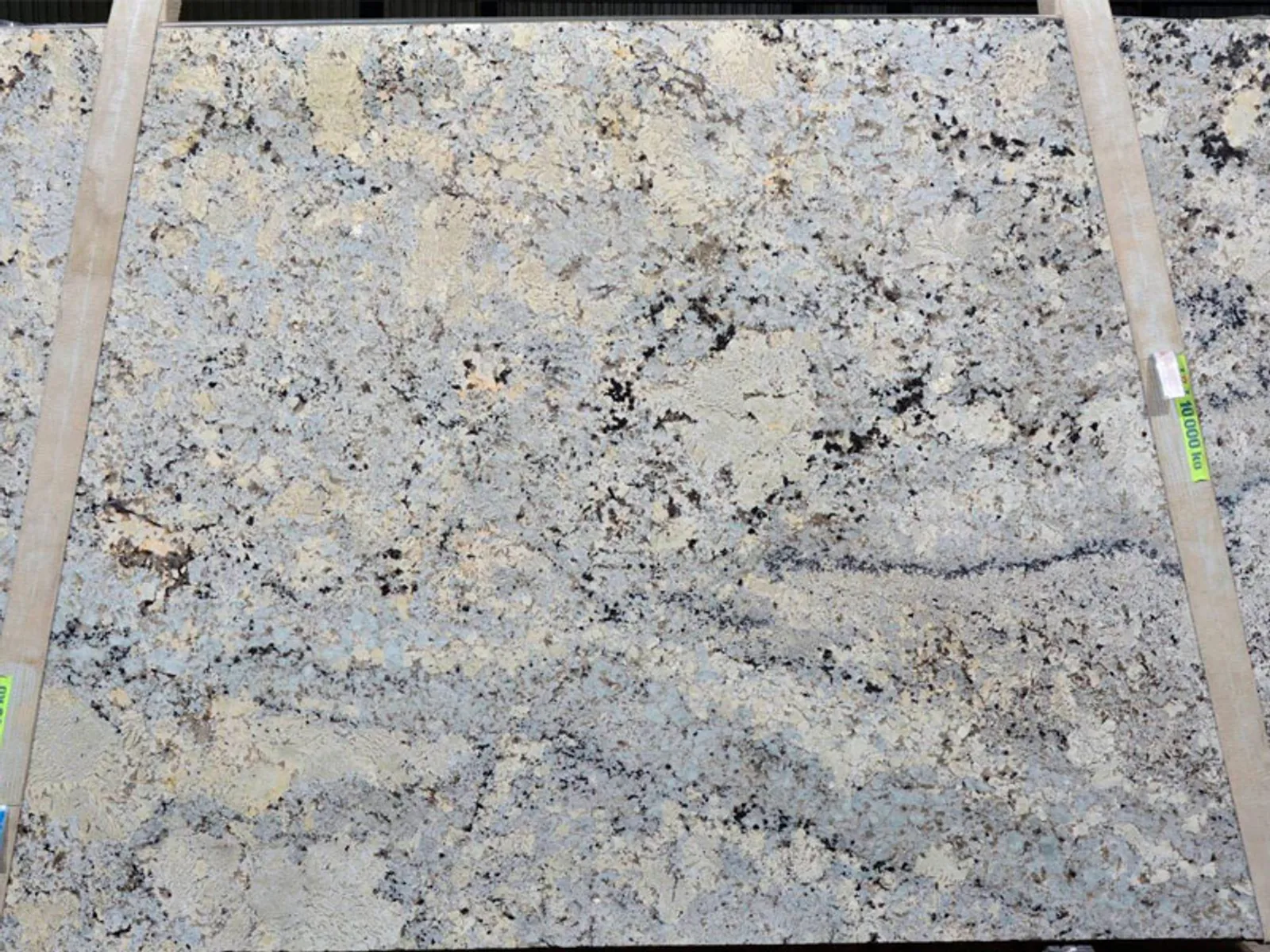
Alaska White
A light granite with gray movement that rewards careful alignment.
See Alaska White graniteTaj Mahal
A quartzite with soft veining where pattern flow across seams matters.
See Taj Mahal quartzite
For dramatic veining, matched pairs such as bookmatched slabs let the pattern mirror across a joint; browse the granite slabs we carry for calmer options too.
Common Seam Mistakes to Avoid
Granite Global hears most seam regrets from projects where the client saw the layout only after the stone was cut. Choosing a bold stone without thinking about joints, skipping the layout drawing or letting an island grow past the slab size are the usual causes. Each one is easy to prevent with a little planning at the slab yard.
- Choosing a dramatic veined stone without asking where the joints will fall.
- Approving the template without seeing a layout drawing of the pieces on the slab.
- Designing an island larger than any slab on the shortlist.
- Mixing slabs from different lots, so color shifts at the seam.
- Expecting a seam to vanish completely under strong raking light.
Bring these points to your fabricator early, and the seams in your finished countertop will look planned rather than accidental.
A Seam Checklist Before Templating
Granite Global recommends settling the seam plan before the fabricator templates your cabinets. Once the stone is cut, moving a seam is rarely possible. A short conversation, a layout drawing and photos of the actual slabs give you a say in where the joints fall and how the pattern flows across them.
- Choose the actual slabs and photograph them with their labels
- Ask how many seams your layout needs and where
- Request a layout drawing showing each piece on the slab
- Ask how veins or movement will line up across each joint
- Confirm seams avoid fragile strips around sinks and cooktops
- Ask how the joint will be filled, leveled and color matched
When you are ready to choose, visit our Charlotte slab warehouse at 7517 Orr Road; walk-ins are welcome and no appointment is needed.
Sources and References
Granite Global links to outside references only for technical points about stone and fabrication. The explanation of why seams become visible comes from the fabrication article below, and the description of granite comes from a public reference. Seam placement details for your kitchen should always be confirmed with your fabricator.
- Kris Jorgensen, “In Pursuit of the Invisible Seam,” Stone World, December 2008 (stoneworld.com): color and vein matching and chip-free edges decide how visible a seam is.
- Wikipedia, “Granite” (en.wikipedia.org/wiki/Granite): granite as a coarse-grained natural igneous rock whose look varies.
Every slab is unique, so the same seam plan can look different from one stone to another.
Questions About Countertop Seams
Will my granite countertop have seams?
Most kitchens have at least one. A seam is needed when a run is longer than the slab, the layout turns a corner, an island is larger than the slab or a piece is too big to carry in safely. Small bathroom vanities often need none. Your fabricator decides based on slab size and layout.
Can a seam be invisible?
A well-made seam can be very hard to see, especially on calm speckled stone. Color and vein matching across the joint, clean chip-free edges and a level surface do most of the work. In raking light you may still notice the line, which is normal in natural stone.
Who decides where the seams go?
Your fabricator plans the seams, because they measure the cabinets and cut the stone. Granite Global supplies the slabs. Ask your fabricator for a layout drawing that marks each seam, explains why it sits there and shows how the pattern will line up before cutting.
Do veined stones show seams more?
Yes. Bold veining makes any break in the pattern easy to see, so veined granite and quartzite need matched pieces and careful layout. Calm, uniform granites hide joints more easily. If you love a dramatic stone, plan the seam locations while you choose the slab.
Can a large island be one piece of stone?
Only if the island fits within a single slab, including the overhang. Measure your island and ask the slab size of each stone on your shortlist. If it does not fit, your fabricator will plan a seam or a different layout. Call (704) 348-4485 to check availability.
Should seams sit over the dishwasher?
Many fabricators avoid placing seams where there is no cabinet box underneath, such as over a dishwasher, and keep them away from thin strips beside sinks and cooktops. Every layout differs, so ask your fabricator how they handle these spots in your kitchen.
Plan Your Seams Around the Real Slabs
Shortlist stone online, call (704) 348-4485 to check availability, then photograph the actual slabs at our Charlotte warehouse so your fabricator can plan every seam.