
Exotic Quartzite: What Makes It Exotic and How to Choose
Exotic quartzite is the name the stone trade gives to quartzites with unusual color, bold movement or crystal-like patterns, from blues and greens to deep veined whites. Granite Global, a family-owned slab distributor in Charlotte, NC, imports stone from Brazil and carries many of these quartzites. This guide explains what makes a quartzite exotic, how to confirm it is real quartzite and how to choose the slab.
Exotic Quartzite: The Short Answer
Exotic quartzite is a natural quartzite whose color or pattern stands out from the usual whites and grays. Granite Global uses the word for stones with blue, green, gold or multicolor movement, translucent crystal areas or very dramatic veining. They share quartzite's hardness, but each slab is one of a kind, so choosing in person is essential.
| Point | Classic quartzite | Exotic quartzite |
|---|---|---|
| Color | White, cream, gray | Blue, green, gold, multicolor or bold contrast |
| Pattern | Soft, even veining | Strong movement, bands or crystal areas |
| Slab-to-slab variation | Moderate | Often high, even within one lot |
| Typical use | Full kitchens, calm designs | Islands, feature walls, bars and vanities |
| How to choose | Compare a few slabs | Choose the exact slab and plan the layout on it |
Granite Global supplies the slabs; your fabricator measures, templates, cuts and installs them, so share the exact slab and lot number with them.
What Makes a Quartzite Exotic
Granite Global explains that the color of a quartzite comes from the minerals mixed in with the quartz. Pure quartzite is usually white to gray. Pink and red tones come from hematite, and colors such as yellow, green, blue and orange come from other minerals. Unusual combinations of those minerals are what make a quartzite exotic.
Quartzite is a nonfoliated metamorphic rock composed almost entirely of quartz, formed when quartz-rich sandstone is altered by heat and pressure, according to Geology.com, which gives it a hardness of about 7 on the Mohs scale.
Wikipedia's quartzite article explains the color sources above and notes that quartzite is mined in Brazil for kitchen countertops. Granite Global is a family-owned distributor with a Brazilian team, and we import stone from Brazil.
Exotic is a trade word, not a grade, so judge each slab by its color, pattern and soundness rather than by the label.
Exotic Quartzite Color Families Granite Global Carries
Granite Global carries exotic quartzites across several color families, and slabs move quickly as they sell and new lots arrive. The examples below are materials we carry. Open each page to see a representative photo, call to check availability, and then plan to see the actual slab, because exotic patterns change a lot from slab to slab.
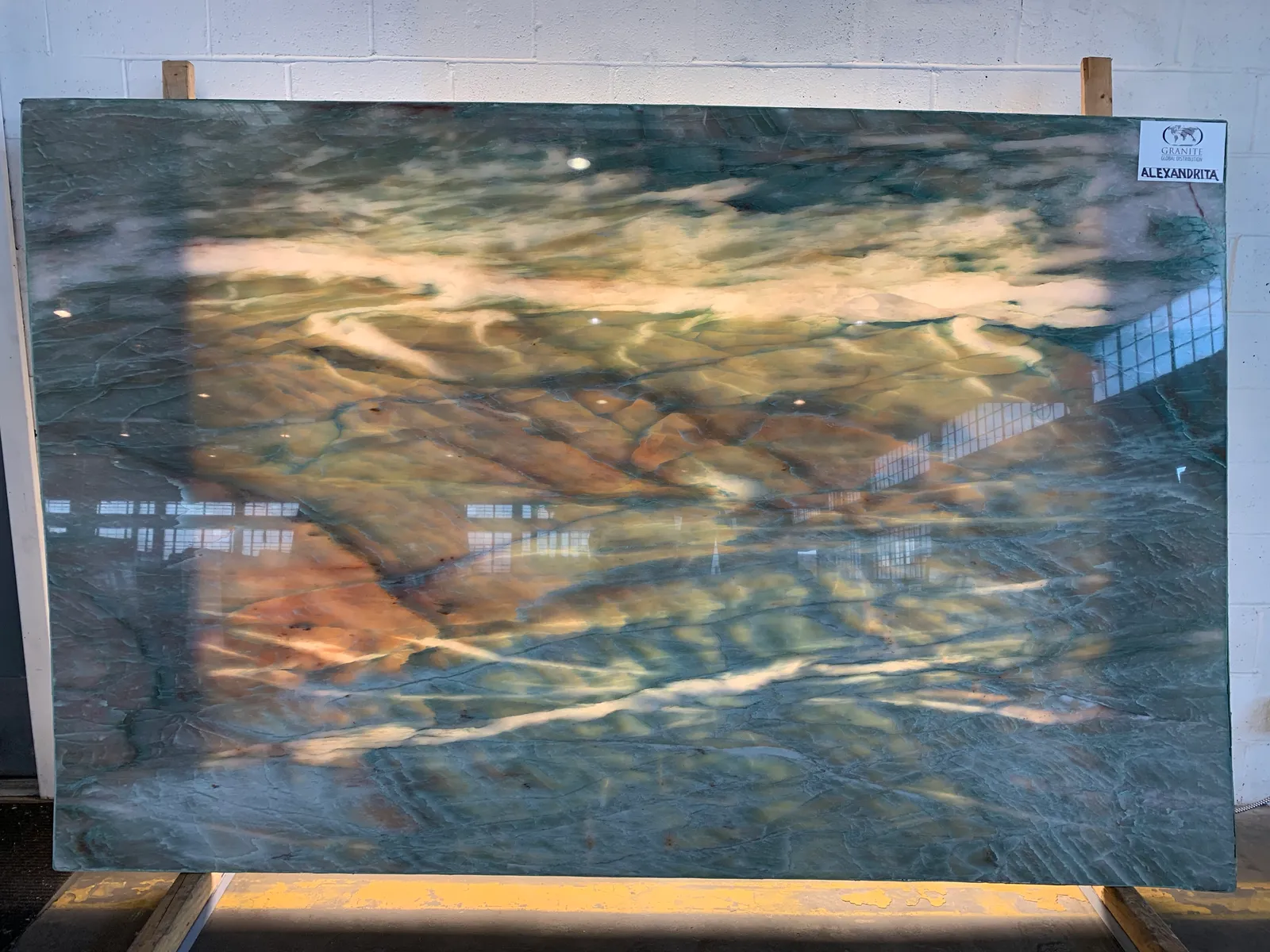
Alexandrita
A green quartzite with sweeping rust, gold and cream movement across the slab.
See Alexandrita quartziteWakanda
A dark gray quartzite with flowing, wave-like lines that read like drawn ink.
See Wakanda quartziteGalactic Core
A black quartzite with bright white streaks scattered like a night sky.
See Galactic Core quartzite
Other quartzites with strong color or character that we carry include Blues, Eiger Alps, Ocean Sunrise, Fusion and Matisse. Names for natural stone are not standardized, so the same stone can carry different names at different suppliers.
Browse all the quartzite slabs in Charlotte we carry to shortlist, then call (704) 348-4485 to check availability before your visit.
How to Check That an Exotic Quartzite Is Real
Granite Global recommends two quick checks, because some stones sold as quartzite are actually marble or dolomitic marble. The Natural Stone Institute notes that true quartzite will scratch glass, cannot be scratched easily with a knife blade and does not etch from lemon juice or vinegar. Test a sample or offcut, never the finished countertop.
| Check | How to do it | What true quartzite does |
|---|---|---|
| Glass test | Press a sharp edge of the sample firmly across a glass tile | Leaves a clear scratch in the glass |
| Etch test | Leave a few drops of lemon juice or vinegar on a polished sample for several minutes, then wipe | No dull spot appears |
The Natural Stone Institute also warns that some stones are mislabeled as quartzite or soft quartzite when they are really marble or dolomitic marble. A single test is a first filter, not a lab identification, so repeat it on more than one spot of a varied slab.
If a sample etches or fails to scratch glass, ask what the stone really is before you plan around quartzite-level durability.
How to Choose an Exotic Quartzite Slab
Granite Global helps customers choose exotic quartzite by planning the layout on the slab itself. With bold patterns, where the island top, the sink cutout and the seams fall matters as much as the color. Pick the slab that holds your favorite area, then have your fabricator place the most striking part where everyone sees it.
| Project | What works | Watch out for |
|---|---|---|
| Kitchen island | One dramatic slab as the centerpiece | Seams through the boldest pattern |
| Full kitchen | Calmer exotic stone, or exotic island with quieter perimeter | Too many busy surfaces together |
| Bar or vanity | Small pieces that show a striking area | Choosing from a photo of the full slab |
| Backsplash or wall | Bookmatched or continuous slabs | Enough slabs from the same lot |
If you want a quieter stone for the perimeter, our guide to granite countertops in Charlotte covers calmer natural options.
Caring for Exotic Quartzite Countertops
Granite Global tells customers that exotic quartzite needs the same simple care as any true quartzite. The Natural Stone Institute recommends a gentle cleanser, water and a soft cloth, and notes that sealing needs range from none at all to regular resealing, depending on porosity. Watch the sink area for darkening that signals a sealer is needed.
- Ask your fabricator whether your slab should be sealed
- Do a water drop test near the sink every few months
- Clean with water, a gentle cleanser and a soft cloth
- Use trivets and cutting boards as good everyday habits
- Wipe oil and colored liquids quickly on light or open areas
- Avoid abrasive powders on polished surfaces
Quartzite never needs oiling, unlike the routine described in our guide to oiling soapstone countertops.
Common Mistakes When Buying Exotic Quartzite
Most regrets Granite Global hears about exotic quartzite come from treating it like a catalog product. Bold stones vary slab to slab, names are not standardized and a few look-alikes are softer than quartzite. Taking time with the real slabs, testing a sample and planning seams with your fabricator avoids nearly every one of these problems.
- Choosing from a photo when every exotic slab is unique.
- Assuming the label proves the stone is true quartzite.
- Not reserving enough slabs from the same lot for a large kitchen.
- Letting a seam or sink cutout land on the most striking part of the pattern.
- Pairing a bold slab with an equally busy backsplash.
Photograph the exact slab and its label, and send the lot number to your fabricator before they plan the cuts.
A Checklist for Seeing Exotic Quartzite in Person
Granite Global recommends coming prepared when you shop for exotic quartzite. Bring your measurements, samples and a phone for photos, and plan to see several slabs, not just the first. Twenty minutes with the real stone in good light shows you color shifts, crystal areas and movement that no photo can capture.
- Bring your fabricator's drawing or measurements
- Bring a cabinet door, flooring sample and backsplash tile
- View each slab from a distance and up close
- Ask to see the other slabs in the same lot
- Ask for a sample or offcut for the glass and etch checks
- Photograph each slab with its label and lot number
When you are ready, visit our Charlotte slab warehouse during business hours; walk-ins are welcome and no appointment is needed.
Sources and References
Granite Global based the technical points in this guide on the sources below: the definition and hardness of quartzite, the minerals that give quartzite its colors and its use from Brazil, and how to recognize true quartzite and care for it. Open each reference to read the original explanation from the source.
- Geology.com: Quartzite (https://geology.com/rocks/quartzite.shtml), definition and Mohs hardness
- Wikipedia: Quartzite (https://en.wikipedia.org/wiki/Quartzite), color sources and quartzite mined in Brazil for countertops
- Natural Stone Institute: Caring for Quartzite Countertops (https://usenaturalstone.org/caring-for-quartzite-countertops/), glass and etch tests, mislabeling, sealing and cleaning
Granite Global reviews these references when the guide is updated.
Questions About Exotic Quartzite
What does exotic quartzite mean?
Exotic is a trade term, not a geological category. It describes quartzites with unusual colors, such as blue, green or gold, strong movement, crystal-like areas or dramatic contrast. Geologically they are still quartzite, a metamorphic rock made almost entirely of quartz. Granite Global uses the word for its most distinctive quartzite slabs.
Is exotic quartzite harder than granite?
Quartzite is made almost entirely of quartz, which gives it a hardness of about 7 on the Mohs scale, so it resists scratches very well. Wikipedia notes it is harder and more resistant to stains than granite. Porosity still varies by slab, so a water drop test is worth doing.
Does exotic quartzite come from Brazil?
Brazil is a known source of quartzite for kitchen countertops, according to Wikipedia's overview of the stone. Granite Global is a family-owned distributor with a Brazilian team that imports stone from Brazil. Ask our team about the origin of any slab you shortlist, since names alone do not tell you where a stone was quarried.
How can I tell if a quartzite is real?
The Natural Stone Institute notes that true quartzite will scratch glass, cannot be scratched easily with a knife blade and does not etch from lemon juice or vinegar. Ask for a sample or offcut and test it. If it etches or barely marks glass, it may be marble or dolomitic marble.
Does exotic quartzite need to be sealed?
It depends on the slab. Sealing needs range from not required at all to regular resealing, depending on the stone's density and porosity. Do a water drop test: if the surface darkens within a few minutes, ask your fabricator about a penetrating sealer, especially around the sink.
Can I see exotic quartzite without an appointment?
Yes. Granite Global welcomes walk-ins at 7517 Orr Road in Charlotte, Monday to Friday from 9am to 5pm and Saturday from 9am to 1pm. Call (704) 348-4485 to check availability before you come, since exotic slabs move as they sell.
Find Your Exotic Quartzite in Person
Shortlist exotic quartzites online, then see the real slabs in our Charlotte warehouse and choose the exact one for your island or kitchen. Call (704) 348-4485 to check availability.